John Wellington's Talisman
The Portable DoorJohn Wellington's Talisman is a compact but exceptionally powerful magical object, entrusted to two of John Wellington Wells’s employees as protection against Humphrey Wells. It was meant to provide the magic needed to free John if his nephew imprisoned or transformed him. Its later disappearance turns that safeguard into a source of uncertainty: the object may be in the strongroom, or a young employee may have taken it without understanding what it is.
Identity and Physical Form
The object is described as a talisman, though John Wellington Wells apparently used another name for it, which his employee could no longer recall. That uncertainty leaves its formal identity less definite than its function. The narrative does not describe its material, appearance, or workings; it establishes its power through the specific task for which John entrusted it to others.
Its physical scale, by contrast, is clear. It was small and light enough to fit in a waistcoat pocket or hang from a watch-chain. Those ordinary means of carrying it made constant custody possible: after receiving it, the two employees ensured that one or the other kept it with him at all times. The contrast between this unobtrusive size and the extraordinary magic attributed to it is central to the object’s significance. It could pass as a minor personal possession while being, in John’s judgment, indispensable to his rescue.
Entrustment and Intended Use
John Wellington Wells gave the talisman to two employees after discovering that Humphrey Wells was plotting with other partners to remove him. Humphrey had grown impatient with John’s repeated talk of retiring, which had continued for two hundred years, and wanted control of the business. John, for his part, had no intention of handing the firm to a nephew whose conduct he regarded as unethical and wicked.
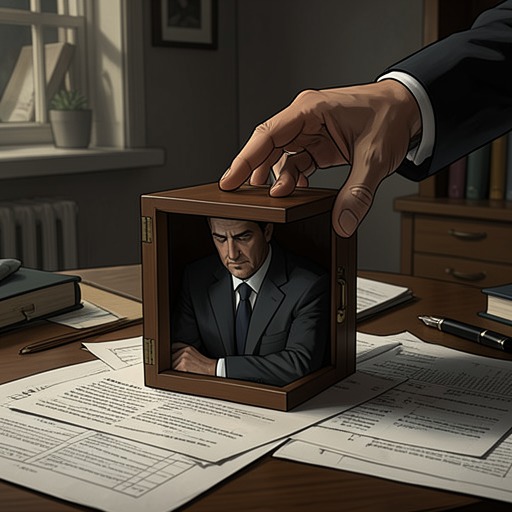
The talisman was a precaution against a particular danger. John told the employees that if Humphrey did something dreadful to him—such as turning him into a frog or imprisoning him in a glass mountain—this object was the only magic powerful enough to ensure his rescue and release. Its role was therefore not described as general protection or as a weapon for confronting Humphrey. It was entrusted as a means of reversing a magical confinement or transformation, should John be rendered unable to free himself.
Humphrey’s Demand
Shortly after the handover, John disappeared. The office account blamed a disastrous job in the West Country involving a love philtre and claimed that John had been sacrificed to the Evil One. His two custodians did not accept this explanation. Given John’s warning, they believed Humphrey was the real threat and considered it their responsibility to discover what had happened and put matters right.
Humphrey soon summoned them to his office and showed that he knew John had given them the talisman. He demanded it, first offering money, then promotion, and finally partnerships in the firm. When they refused, he threatened them with dire consequences. Yet he let them leave without taking the object. The employees found this restraint striking: they believed Humphrey could have compelled them by magic or blasted them with lightning, but he did neither. Their refusal preserved their custody of the talisman for the time being, while Humphrey’s knowledge of its whereabouts made their position precarious.
Disappearance and Disputed Whereabouts
The employees heard nothing more from Humphrey for several weeks. Later, while clearing and organizing the strongroom at the request of Casimir Suslowicz, they encountered the portable-door device among objects delivered by Humphrey’s secretary. The account establishes that they searched the strongroom as part of this work, but it does not explain when or how John’s talisman was lost. By the time its absence becomes a matter of concern, Professor Theo Van Spee and Countess Judy have searched the room repeatedly without finding it.
The disagreement between them reveals how little is known. Professor Theo Van Spee allows for several possibilities: the boy may not have the object at all; even if he does, he may not have used it or know what it can do. He supposes that the boy might treat it as a toy and soon lose interest. Countess Judy rejects this reassurance. Because Dennis Tanner had assigned the young employees to tidy the strongroom, she argues that the job effectively pointed them toward the place where the missing object might be found. She believes the boy has it, believes the other person knows this, and insists that they should be warned. Her suspicion remains an accusation, not a confirmed recovery: the object’s location and the boy’s knowledge are unresolved.
Narrative Significance
The talisman links John’s disappearance to the struggle over control of the firm, but its importance rests on a narrower and more urgent promise: it may be the means of setting John free. That promise is made more consequential by the object’s smallness and uncertain location. A powerful safeguard was entrusted to ordinary employees, kept close to the body, and then became difficult to account for even after repeated searches of the strongroom.
The contrasting responses to its loss sharpen the suspense without resolving it. Professor Theo Van Spee distinguishes possession from understanding and understanding from use; Countess Judy sees the circumstances of the strongroom work as enough reason to act. Neither can prove what the boy has found or what he knows. The talisman thus remains both a practical rescue instrument and an absent object around which competing judgments gather: a potential route to John’s release, but also a danger whose effects cannot yet be measured.